Kagi: Good Enough to Leave Google (search)

I should start by saying that Kagi is a paid product. For those who want to look at what other search engines are out there, Startpage and DuckDuckGo both offer great services free of charge.
Why pay for search?
As the oft-repeated adage goes: "if you're not paying for the product, you are the product". We all know that there's a reason Google can provide the services it does for free. We also all know that this is a bit of an oversimplification, but it's probably a good heuristic to apply to the landscape of software tools nonetheless.
I like the fact that when I search on Kagi, the first hit is actually a hit, not a sponsored result or ad. It feels as though I'm using a direct tool without any advertiser incentives muddying the waters.
In itself, that's not enough to justify the cost for me, but the bundling of the below features pushes me over the fence.
I've been using it as a daily driver for months and I've never once felt the need to switch back. Not one single withdrawal itch.
Lenses
Lenses focus search results down across a narrow field. For example, you can narrow your search to only include Academic or Forum results. Furthermore, you can create your own custom lenses. It's not a feature I tend to use very often, but a neat little one nonetheless.
As an example, I've created a Bearblog lens which only returns *.bearblog.dev sites:
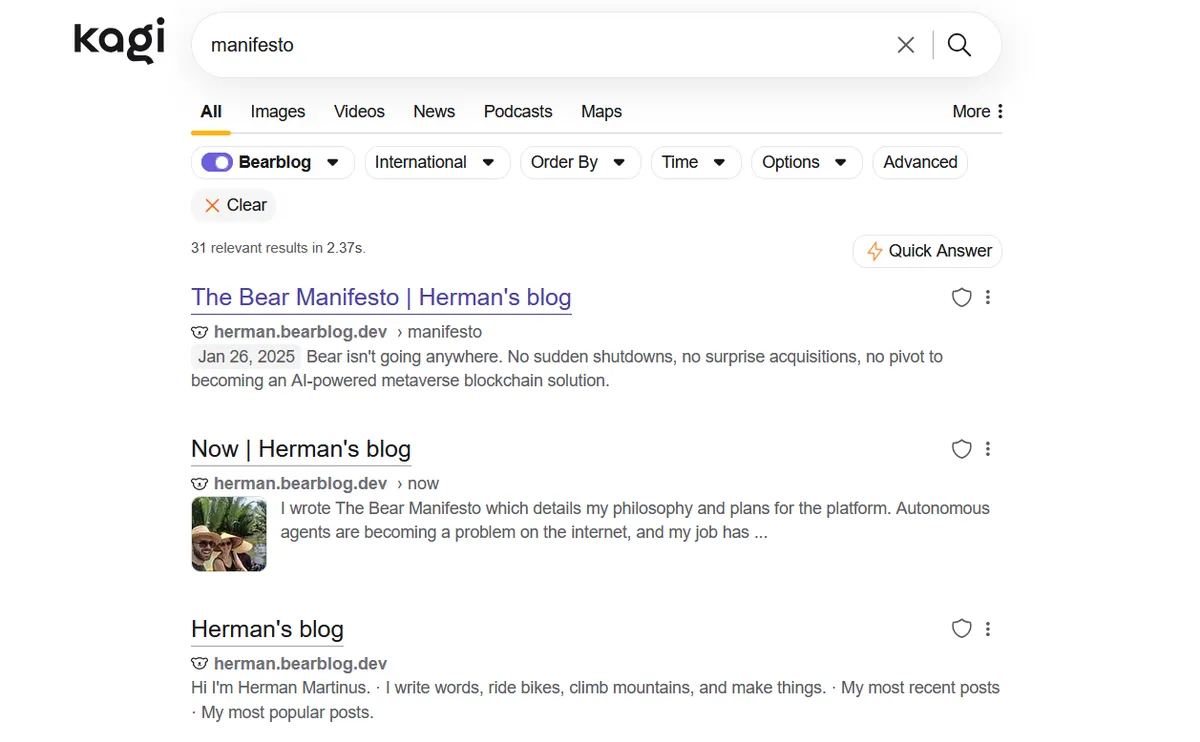
What's really cool is that these lenses can be applied to the lookups undertaken by AI features, which neatly leads me onto the topic of...
AI
Kagi has Quick Answer which serves the same purpose as Google's AI Overview. I'm not going to pretend that it's quite as good or as fast, but it's more than good enough for me. The main thing I like about it is that it's toggle-able. It's off by default and if I want to use it, I can just affix a ? to the end of my query. It's a feature, not a new default mode of search forced onto users.
Kagi also has Assistant - an inference provider for a whole host of well known LLM models. I like the idea of subscribing to this service, instead of directly subscribing to a specific model provider (e.g. via OpenAI's app, or Kimi's app). It means I'm not locked in; I can experiment with whichever model I like best. I can save this preference in a Custom Assistant (CA) which allows me to provide a system prompt describing the behaviour for all interactions used when that specific CA is selected. This CA can then be given a custom name and neatly accessed via the search bar. For example, I've got a CA called jair (James + AI + Reasoning; very creative, I know) which looks like:
| Profile | Jair |
|---|---|
| Model | Kimi K2.6 (Reasoning) |
| Internet Access | yes |
| Lens | entire internet |
With a system prompt of:
Include references wherever possible.
Express uncertainty wherever possible; you should express doubt and avoid over-confident, authoritative statements.
Keep the formatting light; the quality of the information is more important than its presentation.
Take on the role of a professional correspondent. Statements should be direct and to the point. Discard any pleasantries or unnecessary verbosity.
Do not cater to my feelings whatsoever.
If you lack the information required to give a comprehensive and correct answer, prompt me for clarification.
So now I can go and search !jair what is the circumference of the moon and how do we know and it'll give me a result as per my settings above.
As well as flexibility, Kagi as an inference provider also allows for a higher degree of privacy. Not necessarily full privacy, but better than that of most alternatives.
The privacy policy for Moonshot's Kimi app (the model I use via Kagi) states:
1. Personal Information We Collect:
User Content: This includes prompts, audio, images, videos, files, and any content you input or generate while using our products and services. We process this information to provide and improve the Services, including training and optimizing our models. The legal basis for this processing may be our legitimate interests or your consent, depending on your jurisdiction.
Device and Usage Information: We collect information about your device and how you interact with the Services, such as:Device type, model, and operating system;Browser version and user agent;Unique device identifiers (such as device ID, MAC address);Conversation IDs and session identifiers;Network and telecommunications provider;Clipboard data (if applicable and permitted by your settings);Date and time of access, pages viewed, and interaction patterns.This information helps us monitor service performance, troubleshoot issues, and optimize user experience.
This is pretty cookie-cutter; OpenAI, Alibaba, Google, Anthropic, etc. all store user prompts. If they offer a feature to not do so, then it's generally not available within consumer-grade plans.
If every prompt is being recorded, then I can't ask certain things. For 95% of the time throughout daily life, I'm prompting something innocuous. But for that 5% when my prompt is personal or involves information that I'm not comfortable or willing to share, then I'm out of luck. Unless I run a model locally (which is a faff and not all that practical a lot of the time).
Also, note that they state that they can potentially collect clipboard information. As someone who uses a password manager and so relies on the clipboard to sign in to services from time to time, I find that a little scary.
Kagi uses APIs from various services, all of which are set up to have temporary data retention or zero data retention, depending on the model being used. Using Kimi via Kagi, I know that my prompts and associated context files aren't being stored, and that my clipboard isn't being read.
It's worth noting however that Kagi is just acting as the middleman, and so are subject to any policy changes affecting the APIs they use. Furthermore, they state in their privacy policy that prompts "may be retained for a short period of time as a part of request debugging".
It's also worth noting that other LLM providers to offer paid tiers which feature data retention controls.
Small Web
Kagi's small web, as per their blog post:
...typically refers to the non-commercial part of the web, crafted by individuals to express themselves or share knowledge without seeking any financial gain.
This is more of a gimmick than a competitive search feature, but I'd argue that it acts as a good litmus test for their philosophy of the company. That of user control, and an individually expressive, human-centric internet built by people - not by big tech encapsulating their users in their proprietary walled gardens.
To Conclude
I like Kagi. I recommend you give it a go if you haven't (they have a trial). If you find that it's not worth the cost paying for a plan, then by all means give Startpage a go; it used to be my search engine of choice.
Kagi does also have other features that I've not talked about: Translate, News, Summarizer, their own web browser, and a host of other quality-of-life features alongside their search service.
If you have any feedback or disagree with anything I've said, let me know!
A lot of the above experiences are anecdotal; they derive from personal experience. I've not done any systematic tests or comparisons between Kagi and Google Search.